
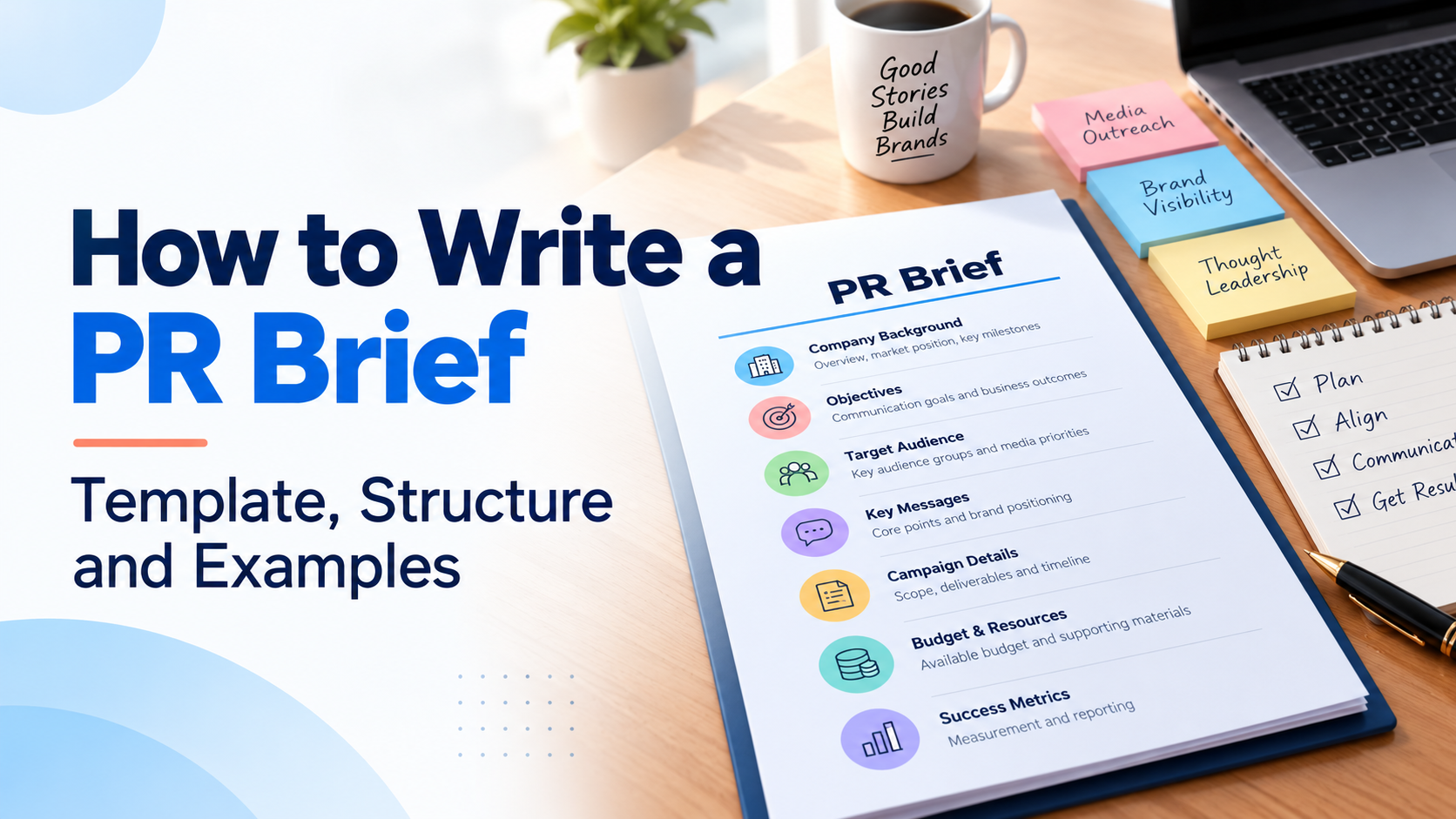
How to Write a PR Brief: Template, Structure and Examples
A successful public relations campaign starts with a clear understanding of what a business wants to communicate, whom it needs to reach and what it hopes to achieve. This is where a well-written PR brief becomes essential.
A PR brief gives a PR agency or communications team the information needed to develop a relevant strategy, identify the right audiences, shape key messages and recommend suitable media outreach activities. Without a clear brief, even a promising campaign can lose direction, leading to unnecessary revisions, misaligned expectations and missed opportunities.
Whether you are planning a product launch, announcing a business expansion, building brand awareness or strengthening corporate reputation, a structured PR brief helps everyone work towards the same objectives.
In this guide, we explain how to write a PR brief, what information to include, and how to use a practical PR brief template with an example.
What Is a PR Brief?
A PR brief is a document that outlines the background, objectives, target audiences, key messages, deliverables, timelines and expectations for a public relations campaign or engagement.
Businesses typically prepare a PR brief when approaching a PR agency, planning a new campaign or aligning internal communications teams. It provides the context that communications professionals need to recommend an appropriate approach.
For example, a company launching a new product may want to generate media coverage, reach potential customers and establish credibility in its industry. A PR brief explains these goals, identifies the intended audience and provides the information required to develop a campaign around them.
A PR brief is not the same as a press release. A PR brief guides the planning and execution of communications activities, while a press release communicates a specific news announcement to the media and other relevant audiences.
Why Is a PR Brief Important?
A well-prepared PR brief helps businesses and communications teams establish clear expectations before a campaign begins.
It aligns campaign objectives. A brief clarifies what the business wants to achieve, whether that means increasing awareness, communicating a new development, building thought leadership or strengthening reputation.
It helps identify the right audience. Understanding who the campaign needs to reach makes it easier to recommend relevant publications, journalists, communication channels and messages.
It improves campaign planning. When the background, objectives and expectations are clear, PR teams can develop more focused strategies instead of spending time clarifying basic requirements.
It supports better use of resources. Sharing budget expectations, timelines and deliverables helps teams recommend activities that are realistic and appropriate for the campaign.
It makes measurement more meaningful. Defining success at the beginning allows the business and PR team to agree on relevant measures, such as media coverage quality, message inclusion, target publication visibility, website engagement or qualified enquiries.
Ultimately, a clear PR brief gives everyone a common reference point throughout the campaign.
What Should a PR Brief Include?
An effective PR brief does not need to be unnecessarily long. It should provide enough information for the PR team to understand the business, the communication challenge and the expected outcomes.
The following sections form a practical structure for most PR briefs.
1. Company Background and Overview
Begin with a short introduction to your company, products or services, industry and current market position.
Include information that helps the PR team understand what the business does and what differentiates it from competitors.
You can include your company history, key milestones, major products, geographic presence, recent developments and relevant achievements.
For example, a technology company preparing to launch an AI-powered platform should explain the problem the platform solves, the customers it serves and why the launch matters to the business.
Keep the background focused on information that will help shape the campaign.
2. PR Objectives and Business Goals
The objective is one of the most important parts of a PR brief. Explain what you want the campaign to achieve and how it supports the wider business goals.
Avoid broad statements such as “We want more publicity” or “We want to become popular.” Instead, identify the specific communication outcome you want to pursue.
Possible objectives include:
- Building awareness of a new product or service.
- Establishing company leadership in a particular industry.
- Communicating a major investment, expansion or partnership.
- Strengthening the credibility of senior executives.
- Reaching a new market or audience.
- Improving understanding of a company’s work or expertise.
Where possible, define measurable indicators and a timeframe. For example, a campaign may aim to secure relevant coverage in selected business publications within a specified period. The target should be realistic and agreed upon with the PR team.
3. Target Audience
A PR campaign becomes more focused when the intended audience is clearly defined.
Identify the people or groups whose awareness, understanding or perception you want to influence. Depending on the campaign, these may include customers, business decision-makers, investors, journalists, employees, industry experts or policymakers.
Consider their interests, information needs, geographic location and preferred media channels.
For example, a B2B technology company targeting enterprise decision-makers may prioritise business publications and technology media, while a consumer product launch may require a different combination of lifestyle, business and consumer-focused outlets.
The more clearly you define your audience, the easier it becomes to develop relevant messages and select suitable communication channels.
4. Key Messages and Brand Positioning
Key messages are the main points you want your audience to understand and remember.
A good PR brief should explain what makes the company, product or announcement relevant, what differentiates it from competitors and what information must be communicated accurately.
Include two or three core messages, supported by facts, examples or evidence wherever possible. Mention any approved company descriptions, terminology, spokesperson details or claims that must be used consistently.
For example, a company introducing a new manufacturing facility might want to communicate its investment, production capabilities and contribution to local employment. The PR team can use these points to shape the announcement and supporting media materials.
Avoid including too many messages. A focused brief helps the campaign communicate a clear and consistent story.
5. Campaign Scope and Deliverables
Explain what you expect the PR team to plan or execute. This helps establish the scope of work before the campaign begins.
Depending on your requirements, deliverables may include:
- Press release drafting and distribution.
- Media outreach and journalist engagement.
- Executive interviews and spokesperson profiling.
- Thought leadership articles or opinion pieces.
- Media briefing materials and talking points.
- Campaign announcements and follow-up communication.
- Media monitoring and campaign reporting.
Not every campaign needs all these activities. The brief should identify the requirements that are already known while allowing the PR team to recommend additional activities where appropriate.
6. Timeline and Important Dates
PR activities often depend on specific dates, especially when the campaign involves a product launch, corporate announcement, event or time-sensitive development.
Include the campaign start date, announcement date, approval deadlines, embargo requirements, event dates and any other important milestones.
Also clarify who will review and approve content, how quickly feedback can be provided and who will be responsible for supplying supporting information.
Providing sufficient time for research, drafting, approvals and media outreach helps the team plan effectively.
7. Budget and Available Resources
If you are approaching a PR agency, provide an indicative budget or budget range where possible. This helps the agency recommend an approach that fits your requirements and available resources.
You should also clarify what resources your organisation can provide, such as spokesperson availability, approved images, research findings, product information, case studies or access to subject matter experts.
If the budget has not yet been finalised, explain that clearly. The agency may be able to suggest different approaches based on the available scope and resources.
8. Competitors and Market Context
Provide a brief overview of the competitive environment and any relevant industry developments.
Identify key competitors, explain how your brand is positioned and highlight what makes the announcement or campaign timely. You can also share previous campaigns, media coverage or communication challenges that may help the PR team understand the context.
This information helps the team identify potential story angles and opportunities to differentiate the brand without making unsupported comparisons or claims.
9. Success Metrics and Reporting
Explain how you intend to evaluate the campaign.
The right measures depend on the objectives. A campaign designed to establish thought leadership may focus on relevant executive coverage, message inclusion and the quality of publications. A product launch may also examine relevant website traffic, audience engagement or qualified enquiries.
Possible measures include:
- Relevant media coverage secured.
- Quality and prominence of media placements.
- Inclusion of agreed key messages.
- Coverage in priority publications or target markets.
- Referral traffic and engagement with campaign-related pages.
- Qualified enquiries or other agreed business indicators.
Agree on the reporting format, frequency and responsibilities in advance. Avoid relying on a single metric, such as the total number of media mentions, to judge the entire campaign.
PR Brief Template: Copy and Use
The following PR brief template can be adapted for a new campaign, product announcement, corporate milestone or ongoing PR engagement.
Project details
- Company name: [Enter company name]
- Campaign name: [Enter campaign name]
- Primary contact: [Name, designation and contact details]
- Brief prepared on: [Date]
- Campaign period: [Start date and end date]
1. Company background
Describe your company, products or services, industry, market presence and relevant business developments.
[Enter company background]
2. Campaign objectives
What do you want the campaign to achieve? Explain the primary objective and any supporting objectives.
[Enter campaign objectives]
3. Target audience
Who do you want to reach? Include relevant audience groups, industries, locations and information needs.
[Enter target audience]
4. Key messages
What are the two or three main points your audience should understand? Include supporting facts or evidence.
[Enter key messages]
5. Campaign details and deliverables
Describe the announcement, campaign requirements and expected deliverables.
[Enter campaign details and deliverables]
6. Media and geographic priorities
Identify any priority publications, media categories, regions or markets, if known.
[Enter media and geographic priorities]
7. Spokespersons and supporting materials
List available spokespersons, their designations, contact arrangements, approved images, research, company profiles and other supporting materials.
[Enter spokesperson and resource details]
8. Timeline and approvals
Include important dates, approval deadlines, launch or announcement dates and the person responsible for sign-off.
[Enter timeline and approval process]
9. Budget and resources
Specify the available budget or budget range and any resources the company can provide.
[Enter budget and resources]
10. Success metrics and reporting
Explain how campaign performance should be evaluated and how often reports should be shared.
[Enter agreed success metrics and reporting requirements]
Additional information
Include any relevant background, restrictions, confidentiality requirements or details that the PR team should know before planning the campaign.
[Enter additional information]
PR Brief Example: New Product Launch
To understand how a PR brief works in practice, consider a fictional technology company preparing to launch a new business software platform.
Project: Launch of a business automation platform
Company background: The company provides software solutions for small and medium-sized businesses. It is introducing a new platform designed to simplify routine business processes.
Campaign objective: Build awareness of the platform among relevant business audiences and establish the company as a credible provider of business automation solutions.
Target audience: Small and medium-sized business owners, operations leaders, technology decision-makers and relevant industry stakeholders in the launch market.
Key messages:
- The platform is designed to simplify selected routine business processes.
- It aims to help businesses manage their workflows more efficiently.
- The launch reflects the company’s focus on practical technology solutions for growing businesses.
Campaign deliverables: A launch press release, relevant media outreach, executive interview opportunities and campaign performance reporting.
Timeline: The campaign is planned around the product launch date, with sufficient time allocated for content preparation, fact-checking and approvals.
Supporting resources: Product information, approved screenshots, executive profiles, company background and a spokesperson available for interviews.
Success measures: Relevant media coverage, inclusion of key messages, visibility in selected publications and engagement with the product information page.
This example illustrates how a PR brief translates a business announcement into a structured communications assignment. The actual media strategy, deliverables and success measures would be finalised with the PR team based on the company’s needs and available resources.
Common Mistakes to Avoid When Writing a PR Brief
Even when a brief contains the necessary sections, certain mistakes can make it difficult for the PR team to develop an effective campaign.
Setting vague objectives: Statements such as “increase visibility” need more context. Clarify which audience you want to reach, what you want them to understand and how progress will be evaluated.
Trying to communicate too many messages: Too many competing priorities can make the campaign unfocused. Identify the most important messages and separate them from supporting information.
Leaving out the target audience: A campaign cannot be planned effectively without understanding whom it needs to reach. Define the priority audience before discussing tactics.
Providing unrealistic timelines: Insufficient time for approvals, research or media engagement can affect execution. Share fixed dates early and agree on a practical schedule.
Ignoring budget and resources: Unclear financial expectations can lead to proposals that do not match the company’s requirements. Share the available budget or explain the constraints.
Measuring only media volume: The number of placements does not automatically reflect campaign quality or business impact. Choose metrics that relate to the original objectives.
A clear, focused brief helps avoid these issues and provides a stronger foundation for campaign planning.
Final Thoughts
A PR brief is more than an administrative document. It is the starting point for a well-planned communications campaign.
By clearly defining the business context, objectives, target audience, key messages, deliverables, timelines and success measures, organisations can help their PR teams develop more relevant strategies and make better use of available resources.
Whether you are preparing a product launch, announcing a corporate milestone or building long-term brand visibility, a structured PR brief brings clarity to the process and gives everyone a shared understanding of what success should look like.
Start with the template in this guide, adapt it to your requirements and refine it with your communications team before the campaign begins.
FAQ
What is a PR brief?
A PR brief is a document that explains the background, objectives, audience, key messages, deliverables and expectations of a public relations campaign. It guides the PR team in developing an appropriate communications strategy.
How do you write a PR brief?
Start by describing your company and the reason for the campaign. Define your objectives, target audience and key messages, then outline deliverables, timelines, budget, available resources and success measures. Keep the brief clear, specific and relevant to the campaign.
What should a PR brief include?
A PR brief should generally include company background, campaign objectives, target audiences, key messages, scope of work, media priorities, timelines, budget, supporting resources and reporting requirements.
What is the difference between a PR brief and a press release?
A PR brief is used to plan a campaign and communicate expectations to the PR team. A press release is a news announcement prepared for distribution to journalists, media outlets and other relevant audiences.
How long should a PR brief be?
There is no fixed length. A straightforward campaign may need only a few pages, while a complex corporate campaign may require more detail. The brief should include all the information needed for planning without unnecessary background or repetition.
Can a PR brief be used for an ongoing PR campaign?
Yes. A PR brief can be used for a one-time announcement, a product launch or an ongoing PR engagement. For longer campaigns, it can serve as a reference document that is updated when objectives, priorities or timelines change.
Why is a PR brief important when hiring a PR agency?
A clear brief helps agencies understand the business, identify the communication challenge and develop proposals suited to the company’s objectives. It also helps establish expectations around scope, timelines, budget and performance evaluation.