
Public Relations Tools and Activities: A Practical Guide
Public relations is an important part of how businesses build brand awareness, communicate with their audiences, establish credibility, and manage their reputation. However, successful PR requires more than distributing press releases or securing media coverage. It involves a combination of strategic planning, communication activities, relationship building, and the right tools to support these efforts.
This is where public relations tools become valuable.
From media monitoring platforms and press release distribution services to social media management and analytics tools, PR professionals use different resources to plan campaigns, communicate stories, monitor brand mentions, and measure results.
At the same time, PR activities such as media outreach, content development, events, interviews, and thought leadership help businesses connect with the audiences that matter.
Understanding how these tools and activities work together can help organisations develop more structured and effective public relations strategies.
Let’s explore the essential public relations tools and activities businesses can use to strengthen their communication efforts.
What Are Public Relations Tools?
Public relations tools are platforms, software, resources, and communication channels that help PR professionals plan, execute, manage, and evaluate public relations campaigns.
They support different aspects of PR, including media relations, content creation, press release distribution, brand monitoring, social media communication, and performance measurement.
For example, a media database can help identify relevant journalists, a press release distribution platform can help share company announcements with media outlets, and a media monitoring tool can track where a brand is being mentioned online.
The right combination of tools depends on an organisation’s objectives, target audience, industry, campaign requirements, and available resources.
Why Are Public Relations Tools Important?
Managing public relations involves multiple activities and communication channels. Without an organised approach, it can become difficult to coordinate campaigns, maintain media relationships, and evaluate performance.
Public relations tools help make these processes more structured and manageable.
1. Improve Media Outreach
Media databases and journalist research tools help PR professionals identify publications, reporters, editors, and media contacts relevant to their industries.
This makes it easier to develop targeted media lists and approach journalists with stories that align with their editorial interests.
2. Simplify Communication and Content Distribution
Press release distribution platforms help businesses share announcements through organised media distribution networks.
They can support the communication of product launches, business developments, partnerships, financial announcements, and other newsworthy updates.
3. Monitor Brand Reputation
Media monitoring tools help businesses track mentions of their company, products, executives, competitors, and industry topics.
This information can help PR teams understand public conversations, identify potential communication issues, and respond to relevant developments.
4. Support Data-Driven Decisions
Analytics and reporting tools help measure the performance of PR campaigns.
By reviewing media mentions, publication relevance, referral traffic, social engagement, and other indicators, businesses can better understand what is working and where improvements are needed.
5. Improve Team Productivity
Tools for content planning, collaboration, scheduling, and reporting can help PR teams organise their work, manage deadlines, and coordinate communication across different channels.
10 Essential Public Relations Tools and Activities
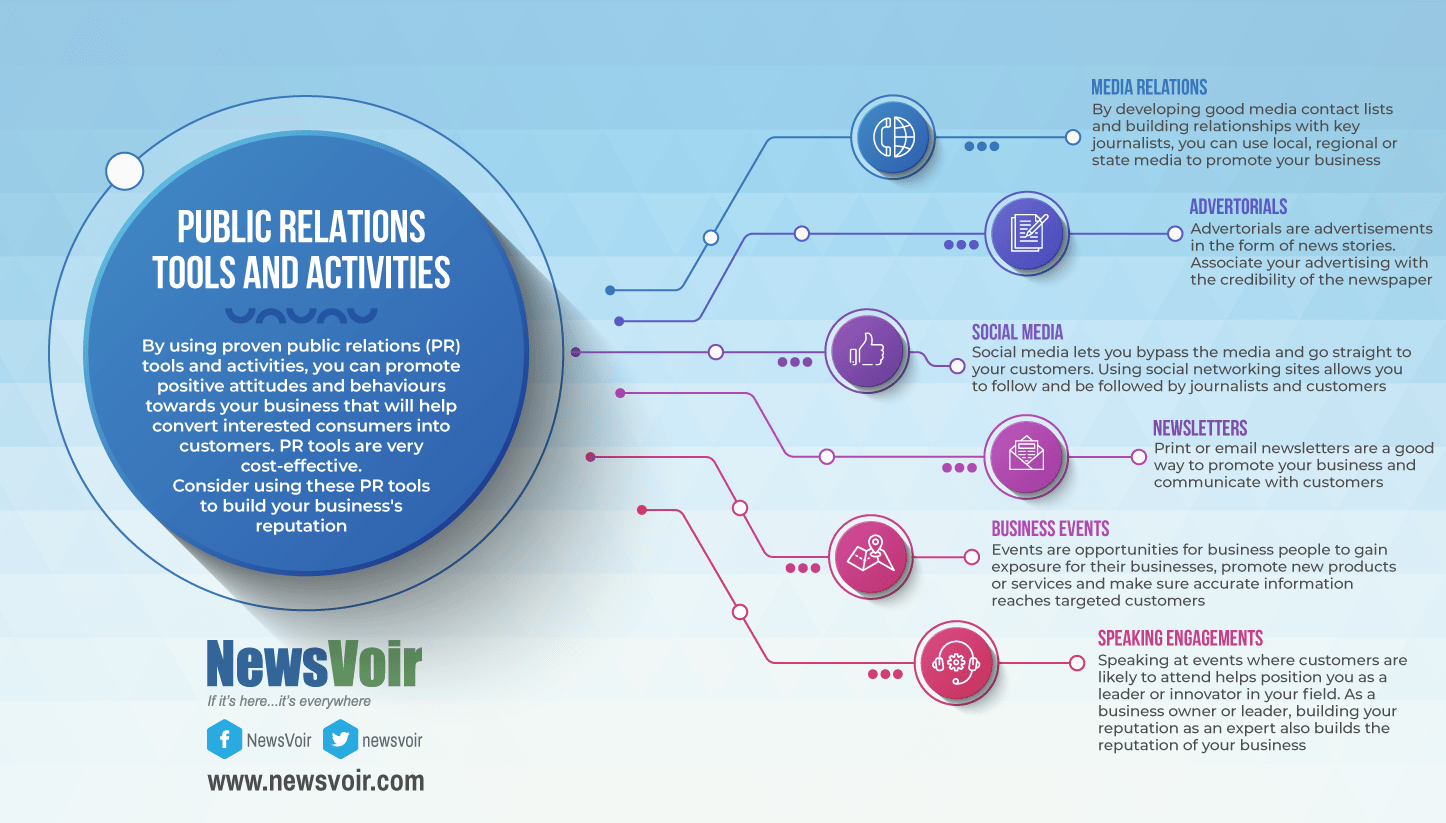
Public relations involves a combination of technology, communication resources, and practical activities. The following tools and activities can help businesses plan and execute their PR strategies more effectively.
1. Media Databases and Journalist Research Tools
Media databases help PR professionals identify journalists, editors, publications, and media contacts based on industry, location, and editorial focus.
They are particularly useful when businesses want to reach journalists who regularly cover their sector.
Popular platforms and resources include:
- Muck Rack: Supports journalist discovery and media relationship research.
- Cision: Offers media database, monitoring, and PR communication solutions.
- LinkedIn: Helps identify journalists, editors, industry professionals, and relevant media contacts.
- Publication websites: Provide useful information about editorial teams, article topics, and contact details.
PR activity: Build targeted media lists, research journalist interests, and develop relevant media outreach campaigns.
The objective is not simply to collect a large number of contacts. It is to identify the right journalists and establish meaningful professional relationships.
2. Press Release Writing and Distribution Tools
Press releases remain an important PR communication format for sharing business announcements and newsworthy developments.
A well-written press release provides journalists with structured information about an organisation, its announcement, and its relevance.
Businesses can use press release distribution services to share announcements with relevant media outlets and audiences.
A press release may communicate:
- New product or service launches.
- Business expansions and market entries.
- Strategic partnerships and collaborations.
- Funding and investment announcements.
- Financial results and corporate developments.
- Awards, achievements, and milestones.
- Research findings and industry insights.
- Corporate social responsibility initiatives.
PR activity: Develop newsworthy announcements, prepare press releases, and distribute them through appropriate media channels.
NewsVoir supports businesses with press release distribution, corporate announcements, and multimedia communication to help organisations share their news with media platforms.
3. Media Monitoring and Brand Listening Tools
Media monitoring tools help organisations track what is being published or discussed about their brand, competitors, products, and industry.
These platforms can monitor online publications, blogs, news websites, and other available digital sources. Some also provide social media listening and alerts.
Examples include:
- Google Alerts: Provides email notifications about newly indexed online content matching selected search terms.
- Meltwater: Offers media monitoring, social listening, and analytics solutions.
- Mention: Supports online brand monitoring and mention tracking.
- Brandwatch: Provides social listening and consumer intelligence capabilities.
PR activity: Monitor brand mentions, identify industry conversations, track competitor visibility, and review public discussions.
Regular monitoring can help businesses understand how their brand is being discussed and identify communication opportunities or potential reputation concerns.
4. Social Media Management Tools
Social media has become an important part of public relations because it allows businesses to communicate directly with their audiences.
Platforms such as LinkedIn, Facebook, Instagram, and X provide opportunities to share company updates, engage with customers, communicate announcements, and participate in industry conversations.
Social media management tools help organise and schedule content across multiple platforms.
Examples include:
- Hootsuite: Supports social media scheduling, management, and monitoring.
- Buffer: Helps plan and schedule social media content.
- Sprout Social: Provides social media management, engagement, and reporting capabilities.
- LinkedIn: Offers a professional platform for business communication, leadership visibility, and industry engagement.
PR activity: Share media coverage, publish company announcements, communicate brand updates, and engage with relevant audiences.
A consistent social media strategy can help extend the visibility of PR content beyond its original publication channel.
5. Content Creation and Editing Tools
Content plays an important role in public relations. Press releases, articles, blogs, newsletters, presentations, and social media creatives all contribute to how a business communicates its story.
Content creation tools can help PR teams develop professional and consistent communication materials.
Some useful tools include:
- Canva: Helps create social media graphics, presentations, and visual communication materials.
- Grammarly: Supports grammar, spelling, and writing clarity.
- Google Docs: Enables collaborative writing, editing, and document sharing.
- Microsoft Word: Supports drafting and formatting professional documents.
- ChatGPT: Can assist with brainstorming, outlining, drafting, and refining communication content, with human review for accuracy and tone.
PR activity: Develop press releases, thought leadership articles, corporate blogs, newsletters, media pitches, and supporting visual content.
The focus should always remain on accurate information, a clear message, and content that offers value to the intended audience.
6. Website Analytics and Reporting Tools
PR campaigns can generate traffic and engagement through media coverage, press releases, backlinks, social media posts, and other communication channels.
Analytics tools help businesses understand how audiences interact with their digital platforms.
Useful tools include:
- Google Analytics 4 (GA4): Helps measure website traffic, user engagement, and referral sources.
- Google Search Console: Provides information about website search performance, queries, clicks, and impressions.
- Looker Studio: Helps create visual reports and dashboards using connected data sources.
PR activity: Measure website traffic from media coverage, review referral sources, monitor relevant search performance, and prepare campaign reports.
For example, if a company receives media coverage containing a link to its website, analytics can help identify referral visits from that publication when tracking is available.
It is important to distinguish between estimated media reach and actual website visits. They measure different aspects of campaign performance.
7. Email Outreach and Communication Tools
Email remains an important communication channel for PR professionals.
It is commonly used to send media pitches, share press releases, respond to journalist enquiries, coordinate interviews, and communicate with stakeholders.
Tools such as Gmail, Outlook, and professional email platforms can help manage communication.
Email outreach platforms may also support personalisation, contact organisation, and campaign tracking, depending on their features.
PR activity: Develop personalised media pitches, share relevant announcements, follow up professionally, and maintain communication with media contacts.
A good media email should be concise, relevant, and tailored to the journalist’s area of coverage. Avoid sending repetitive or generic messages to large contact lists.
8. Event Management and Networking Tools
Events provide opportunities for businesses to communicate with audiences, introduce new developments, build relationships, and engage with industry professionals.
These may include product launches, press conferences, media briefings, conferences, webinars, and networking events.
Event management platforms can help with registrations, invitations, scheduling, and attendee communication.
Examples include:
- Eventbrite: Supports event creation, registration, and ticketing.
- Zoom: Facilitates online meetings, interviews, and webinars.
- Microsoft Teams: Supports virtual meetings and collaboration.
- LinkedIn Events: Helps promote professional events and encourage participation.
PR activity: Organise press conferences, product launches, media interactions, webinars, and industry networking events.
Events should have clear objectives and provide a relevant experience for attendees rather than being organised solely for publicity.
9. Influencer and Creator Research Tools
Influencer and creator collaborations can support PR and brand communication by helping businesses connect with audiences through relevant voices.
Influencer research tools can help identify creators based on their content categories, audience characteristics, engagement, and geographical focus.
Examples include:
- Modash: Supports influencer discovery and analysis.
- HypeAuditor: Provides influencer analytics and audience insights.
- CreatorIQ: Offers creator marketing management and analytics solutions.
PR activity: Identify relevant creators, develop collaborations, coordinate interviews or product experiences, and evaluate campaign outcomes.
Businesses should prioritise audience relevance, content quality, authenticity, and appropriate disclosure of paid partnerships.
10. Crisis Communication and Reputation Management Resources
Every organisation should be prepared to respond to unexpected events that may affect its public reputation.
A crisis communication plan helps businesses define responsibilities, approval processes, spokespersons, and communication procedures before a situation arises.
Monitoring platforms, internal communication tools, media contact databases, and prepared response guidelines can support this process.
PR activity: Monitor emerging issues, prepare communication responses, coordinate spokesperson communication, and provide accurate updates to relevant stakeholders.
The speed of a response matters, but accuracy and consistency are equally important. Businesses should verify information before issuing public statements.
How to Choose the Right Public Relations Tools
There is no single PR tool that can manage every aspect of public relations. Businesses should select tools based on their communication requirements and campaign objectives.
Consider the following factors before investing in a platform.
1. Identify your PR objectives: Decide whether your priority is media outreach, press release distribution, brand monitoring, social media engagement, or performance measurement.
2. Understand your audience: Choose tools that help you reach the journalists, customers, stakeholders, and industry professionals relevant to your business.
3. Review features and usability: Consider the platform’s functionality, reporting capabilities, integrations, ease of use, and learning requirements.
4. Evaluate cost and scalability: Compare subscription fees, usage limits, and available plans against your expected requirements.
5. Check data quality: For media databases and monitoring platforms, assess the relevance, accuracy, and coverage of the information provided.
6. Measure practical value: Evaluate whether the tool saves time, improves communication, supports better decisions, or helps achieve measurable campaign objectives.
The best approach is to build a combination of tools that supports your PR workflow without making it unnecessarily complicated.
How to Measure the Success of PR Tools and Activities
Using public relations tools is only one part of an effective PR strategy. Businesses also need to understand whether their activities are contributing to communication objectives.
Some useful performance indicators include:
| PR activity | Possible performance indicators |
|---|---|
| Media relations | Relevant journalist engagement, media responses, and interview opportunities |
| Press release distribution | Distribution performance, published coverage, and publication relevance |
| Media monitoring | Brand mentions, share of voice, and coverage sentiment |
| Social media communication | Engagement, shares, comments, and referral traffic |
| Content creation | Content engagement, readership, and audience response |
| Website analytics | Referral traffic, engaged sessions, and relevant conversions |
| Events and webinars | Registrations, attendance, participation, and follow-up opportunities |
| Influencer collaborations | Relevant reach, engagement, content performance, and audience response |
| Crisis communication | Response time, message consistency, and issue resolution |
Not every activity should be measured using the same metric. For example, the number of press releases distributed does not necessarily indicate how much meaningful media coverage was achieved.
Businesses should evaluate both the quality of their communication and the outcomes generated.
Final Thoughts
Public relations involves much more than distributing announcements or securing media coverage. It requires a combination of research, communication, relationship building, content development, monitoring, and performance measurement.
The right public relations tools can make these activities more organised and efficient, while a well-planned PR strategy ensures that each activity supports a clear communication objective.
Businesses do not need to use every available platform. They should identify their priorities, choose tools that meet their requirements, and focus on activities that help them reach relevant audiences.
By combining the right tools with consistent PR activities, organisations can strengthen brand visibility, build credibility, and develop meaningful relationships with the media and their stakeholders.
Frequently Asked Questions (FAQs)
1. What are public relations tools?
Public relations tools are software platforms, resources, and communication channels that help businesses plan, execute, manage, and measure PR activities. Examples include media databases, press release distribution services, media monitoring platforms, social media management tools, and analytics software.
2. What are the most commonly used PR tools?
Commonly used PR tools include media databases such as Muck Rack and Cision, monitoring platforms such as Meltwater and Mention, content tools such as Canva and Grammarly, social media management platforms such as Buffer and Hootsuite, and analytics tools such as Google Analytics 4 and Google Search Console.
3. What are the main activities in public relations?
Key PR activities include media relations, press release writing and distribution, journalist outreach, media monitoring, social media communication, content development, event management, influencer engagement, thought leadership, and crisis communication.
4. What is the difference between PR tools and PR activities?
PR tools are the platforms and resources used to support communication work, while PR activities are the tasks carried out to achieve public relations objectives. For example, a media database is a PR tool, whereas researching journalists and building media relationships are PR activities.
5. How do media monitoring tools help businesses?
Media monitoring tools help businesses track brand mentions, news coverage, competitor activity, and industry conversations. This information can help PR teams understand public perception, identify relevant opportunities, and respond to emerging issues.
6. Are free public relations tools available?
Yes. Businesses can use several free or free-tier resources to support PR activities. Examples include Google Alerts for monitoring selected online mentions, LinkedIn for professional networking, Google Analytics 4 for website measurement, Google Search Console for search performance, and Canva’s free plan for basic visual content creation. Features and usage limits may vary.
7. How can small businesses manage PR activities with a limited budget?
Small businesses can begin with essential tools such as LinkedIn, Google Alerts, Google Analytics 4, Google Docs, and Canva. They can focus on relevant media outreach, useful content, industry networking, and well-planned press releases before investing in more specialised platforms.
8. How can businesses measure the effectiveness of PR activities?
Businesses can measure PR through media coverage, publication relevance, brand mentions, journalist engagement, social media interactions, website referral traffic, backlinks, and audience engagement. The choice of metrics should depend on the objectives of each campaign.
More Information
Explore more insights on public relations, media relations, and communication strategies:
- Media Relations Tools That Support Stronger PR Work
- How to Build Strong Relationships With Business Media
- How to Build and Manage Your Personal PR
Looking to distribute your company’s news to relevant media platforms? Explore NewsVoir’s press release distribution services.